Renting Out a Granny Flat in NSW: 2026 Rules 🏡✨
Thinking about renting out your granny flat in NSW? The good news is simple: it’s allowed, and has been for years. 🎉
But a few details still matter. Your approval type, your tenancy paperwork, how you plan to rent it (Airbnb or landlord), and landlord rules for 2026. All affect what you need to do next. 📑
This guide, Renting Out a Granny Flat in NSW, breaks it all down, step by step. 🛣️
Can You Legally Rent Out a Granny Flat in NSW? ⚖️
Yes. Under the Housing SEPP (formerly the Affordable Rental Housing SEPP), you can rent an approved granny flat, or secondary dwelling, to anyone. 👥
What you can do | Details |
|---|---|
Rent to a stranger 👥 | Allowed, once your granny flat has valid approval |
Rent to family 👨👩👧 | Also allowed, no restriction either way |
Treat it as a rental property 📈 | NSW tenancy law applies, same as any house or unit |
There’s no special “granny flat rental permit.” Once it’s approved as a dwelling, you can lease it. 🔑
For the full approval rules, see our Granny Flat Requirements NSW guide. 📖
Does Your Approval Type Affect Who You Can Rent To? ⚠️
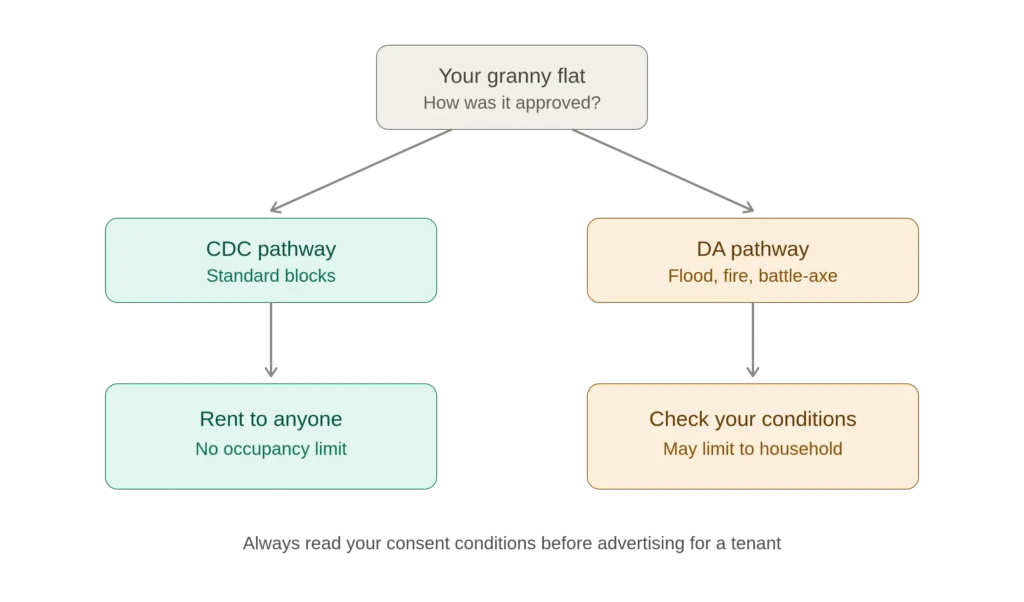
This is the part most owners miss. Your approval pathway can limit your rental options.
⚡ CDC-approved granny flat → No occupancy restriction. Rent to anyone.
🏛️ DA-approved granny flat (fire-prone, flood-prone, or battle-axe blocks) → May carry a condition limiting occupancy to a member of your household only.
If your granny flat needed a DA because of your site conditions, check your consent conditions carefully. Some DA approvals restrict who can live there, unless you apply to have that condition varied. 🔍
For the difference between the two pathways, see our NSW Granny Flat Approval: DA vs CDC guide. 📑

What Tenancy Agreement Do You Need? 📄
Once you’re clear to rent, treat the process like any other rental property.
✍️ Use a standard Residential Tenancy Agreement – the same lease used for a house or apartment
🚗 Set out access clearly – note what the tenant can use, like yard space or a parking spot
🔒 Lodge the bond – pay it into the NSW Rental Bond Board, just like any other rental
📁 Keep records – save your approval documents in case a tenant or authority asks
Even though your granny flat sits on the same title as your main house, it’s treated as its own dwelling for the lease. 🏠
What Are Your Obligations as a Landlord? 🛡️
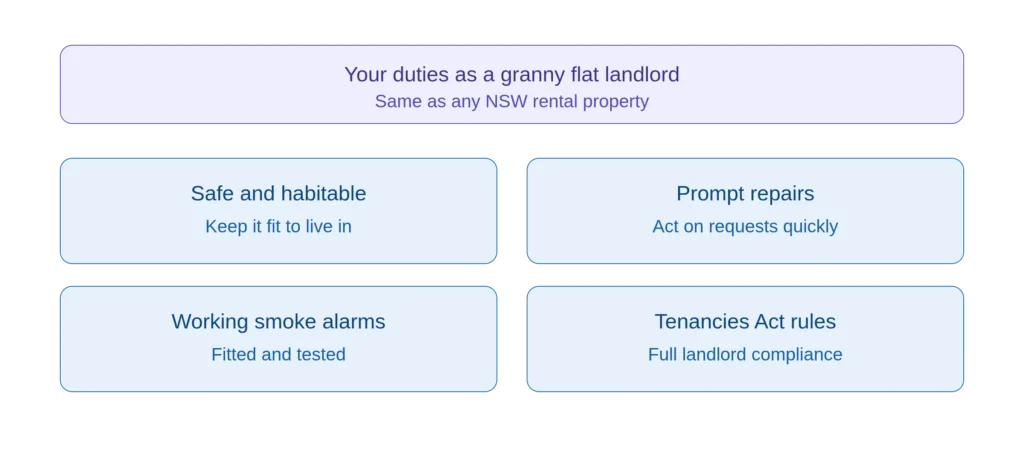
Renting out a granny flat comes with the same duties as renting any property in NSW.
Obligation | What it means |
|---|---|
Safe and habitable condition 🏠 | Keep the property fit to live in at all times |
Repairs 🛠️ | Handle repair requests promptly, as required by law |
Smoke alarms 🔔 | Keep working smoke alarms fitted and tested |
Residential Tenancies Act compliance 📜 | Follow the same rules as any residential landlord in NSW |
Can You Rent Your Granny Flat as an Airbnb? 🧳
You can, but short-term rentals are subject to additional rules. From mid-2025, NSW tightened its Short-Term Rental Accommodation (STRA) rules. ⚠️
🏡 Long-term rental – no special registration needed, beyond your standard approval
🏖️ Short-term/Airbnb rental – you must register on the STRA register and display your registration number
🏛️ Check your council – some councils apply extra local conditions on top of the state STRA rules
If you’re unsure which category your rental plan falls into, a quick check with your council avoids a compliance headache later. 📞
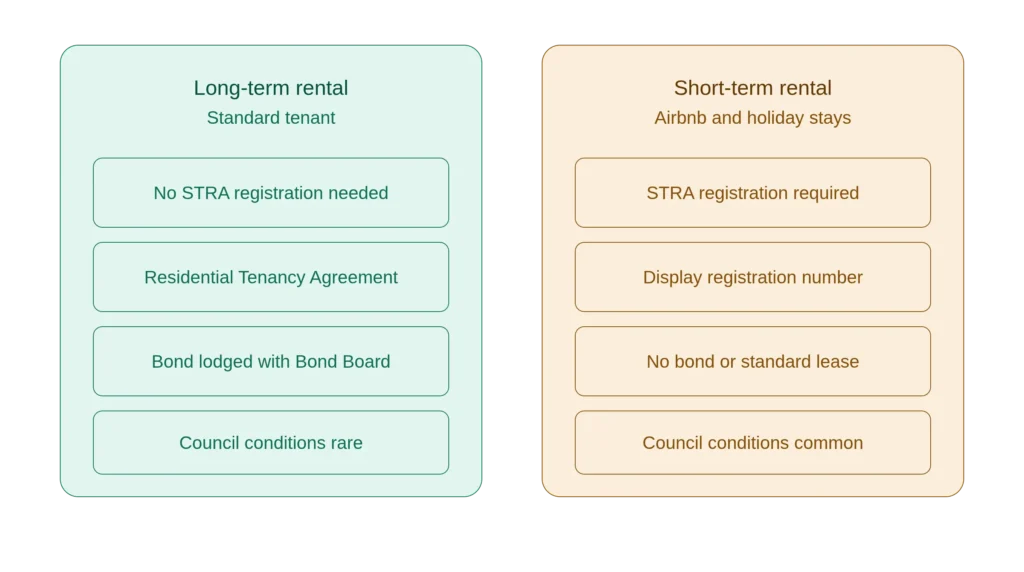
Long-Term Rental vs Short-Term Rental in NSW 📊
Factor | Long-Term Rental 🏠 |
|---|---|
Registration | Not required |
Tenancy agreement | Standard Residential Tenancy Agreement |
Bond | Lodged with Rental Bond Board |
Council conditions | Rare |
Is Renting a Granny Flat a Good Investment in NSW? 📈
Rental rules aside, plenty of NSW homeowners see strong returns from a granny flat. Your suburb, size, and finish level all shape what you can expect to earn. 💰
For a full breakdown of NSW rental yields and returns, see our upcoming Granny Flat ROI NSW guide. 📖
Final Thoughts: Rent With Confidence 🏁
Renting out a granny flat in NSW is straightforward for most owners. Run through this checklist before you list it:
✔ Confirm your approval type (CDC or DA) and any occupancy conditions
✔ Prepare a standard Residential Tenancy Agreement
✔ Lodge the bond with the NSW Rental Bond Board
✔ Check smoke alarms and safety compliance
✔ Confirm STRA registration if renting short-term
Get these sorted, and you’re ready to rent with confidence. 🌟
Ready for the next step? Check our Granny Flat Requirements NSW, NSW Granny Flat Approval: DA vs CDC, and NSW Granny Flat CDC Checklist guides. 🚀