
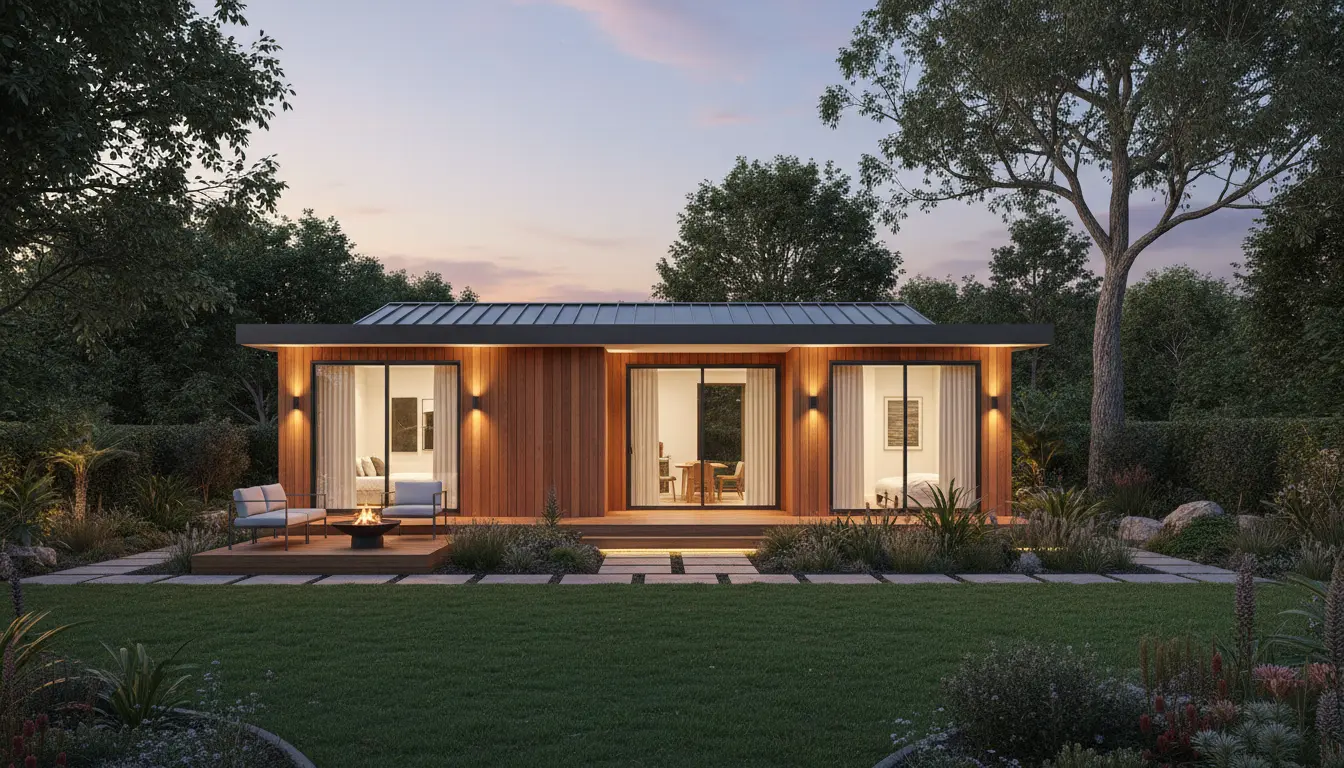
A granny flat is a self-contained living unit built on the same property as your main home. It has its own private entrance, kitchen or kitchenette, bathroom, and sleeping area — everything a person needs to live independently.
Despite the name, granny flats are not just for grandparents. Australians use them for rental income, adult children, home offices, and guest accommodation.
What Makes Something a Granny Flat?
Two things define a granny flat legally in Australia. Both must be present — if either is missing, it is not a granny flat in the eyes of your council or state planning authority.

1. Independent Living Space
Its own private entrance, kitchen or kitchenette, bathroom, and sleeping area. The kitchen is what separates a granny flat from a guest room — it is designed for self-sufficient, long-term living.
2. Accessory to the Main Home
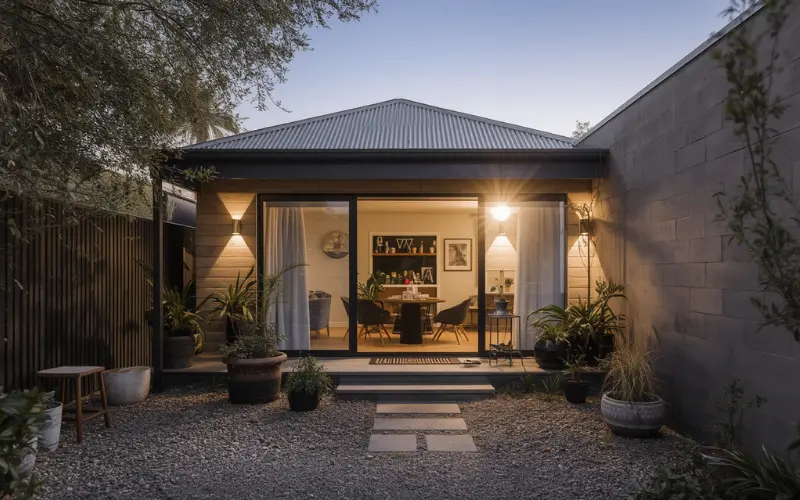
Always on the same legal property as the primary residence. It cannot be sold separately — it is a permanent fixture of the property, not a temporary or mobile structure.
Key point: If a structure has both of these characteristics, it is legally a granny flat — regardless of what it looks like or what you call it.
What Are the Other Names for a Granny Flat?
You will see these terms used interchangeably across Australia. Knowing the official term for your state saves time when searching council websites and planning portals.
| Term | Where You’ll See It |
|---|---|
| Granny flat | Everyday conversation, builder quotes |
| Secondary dwelling | NSW, VIC, QLD planning documents |
| Accessory dwelling unit (ADU) | Government portals, architects |
| Ancillary dwelling | WA planning documents |
| Dependent person’s unit | Some VIC and QLD council schemes |
How Big Is a Granny Flat in Australia?
Size limits vary by state — and this is one of the first things to check before planning your build. Exceeding the limit without a DA means your build may be illegal and uninsurable.
A 60sqm granny flat comfortably fits two bedrooms, one bathroom, and an open-plan kitchen and living area. It is smaller than a standard apartment but larger than most people expect.
What Size Granny Flat Can You Build Without a Permit?
In NSW, a granny flat under 60sqm on a 450sqm+ lot qualifies for CDC — a fast-track private certifier approval that bypasses full council DA. In other states, a building permit is always required regardless of size.
| State | Max Size (no DA) | Min Lot Size | Approval Type | Typical Timeframe |
|---|---|---|---|---|
| NSW | 60sqm | 450sqm | CDC (private certifier) | 10–20 business days |
| VIC | 60sqm | 300sqm | Building permit | 4–10 weeks |
| WA | Up to 70sqm | 450sqm | Building permit (BA) | 4–8 weeks |
| QLD | Up to 80sqm | 600sqm | Code-assessable DA | 6–12 weeks |
⚠️ Always check your local council — state rules set the ceiling but your council often sets tighter limits on setbacks, height, and design. → Granny Flat Regulations Australia 2026
Types of Granny Flats in Australia
When people think of a granny flat, they picture a small house in the backyard. That is the most common type — but there are three distinct options, each suiting a different property and budget.

Detached Granny Flat
A freestanding building completely separate from the main house — the classic backyard granny flat.
- Maximum privacy for both households
- Best rental appeal — feels like a standalone home
- No shared walls — no noise transfer
- Can have its own outdoor space

Attached Granny Flat
Built onto the side or rear of the main home, sharing a common wall but with its own separate entrance.
- Cheaper than detached — shares structure
- Shares some utilities — lower connection costs
- Suits smaller lots where space is limited
- Still fully self-contained

Internal Conversion
An existing part of your home — garage, basement, or large room — converted into a legal self-contained unit.
- Lowest build cost — existing structure used
- No outdoor space required
- Faster to complete than a new build
- Good option for narrow or small lots
Which type suits you? If rental income is the goal, detached wins every time — tenants pay more for privacy. If budget is the priority, an internal conversion or attached unit saves $20,000–$50,000 on build cost.
What Are Granny Flats Used For?

Modern granny flats serve far more purposes than housing elderly relatives. In 2026, rental income is the primary driver for most Australian builds — but the versatility of a granny flat is what makes it such a smart investment.
Rental Income
The most common reason Australians build in 2026. Metro granny flats rent for $350–$650 per week. At $450/week, that is $23,400 per year in passive income.
Multigenerational Living
Aging parents or adult children living privately on the same property — close enough to help, independent enough to maintain their own space.
Home Office
A dedicated workspace away from household distractions — increasingly popular since 2020. A full kitchen means you never need to go back inside during the day.
Guest Accommodation
A comfortable private space for visiting family — a huge upgrade from an air mattress. Guests have their own bathroom, kitchen, and entrance.
Short-Term Rental
Listed on Airbnb or Stayz where local council permits it. Short-term rental rates are typically 30–60% higher than long-term rent in high-tourism areas.
Personal Retreat
Art studio, yoga space, music room, or quiet library — a private sanctuary that keeps hobbies separate from the main home.
How Much Does a Granny Flat Cost in Australia?
Build costs in 2026 depend on size, finish, and state. The figures below are all-in construction estimates — they exclude site preparation, council fees, and utility connections which add $15,000–$50,000 on top.
| State | Budget | Mid-Range | Premium |
|---|---|---|---|
| NSW (Sydney) | $130k–$155k | $155k–$195k | $195k–$240k |
| WA (Perth) | $115k–$140k | $140k–$175k | $175k–$215k |
| VIC (Melbourne) | $125k–$150k | $150k–$185k | $185k–$225k |
| QLD (Brisbane) | $110k–$140k | $140k–$170k | $170k–$210k |
Hidden costs to budget for: Site preparation ($3k–$15k), council/DA fees ($2k–$8k), utility connections ($5k–$20k), driveway or access works ($2k–$8k). These can add $15,000–$50,000 to your base build cost. → Full Hidden Costs Guide
→ For a full state-by-state breakdown see the Granny Flat Cost Australia Guide.
Granny Flat vs Tiny House vs Guest Room
Many people confuse granny flats with other dwelling types. The differences matter legally — getting this wrong affects your approval, insurance, and property value.


| Feature | Granny Flat | Tiny House | Guest Room | Home Addition |
|---|---|---|---|---|
| Foundation | Permanent slab | Usually on wheels | Part of main home | Permanent |
| Kitchen required | Yes — full kitchen | Basic only | No | Optional |
| Own entrance | Yes | Yes | No | No |
| Legal status | Secondary dwelling | Caravan/vehicle | Ancillary space | Primary dwelling ext. |
| Adds property value | Yes — significant | No | Minimal | Yes |
| Can be rented | Yes (with approval) | Restricted | No | No |
| Size range | 60–80sqm | Up to 50sqm | Part of main home | Varies |
Do You Need Council Approval for a Granny Flat?
Yes — but in most states the process is straightforward if your property meets standard requirements. Here is what each state requires.
🔵 New South Wales
- Fast-track: CDC approval via private certifier
- Timeframe: 10–20 business days
- Condition: Lot 450sqm+, build under 60sqm
- DA needed when: Lot under 450sqm or over 60sqm
🟤 Victoria
- Fast-track: Building permit (no CDC equivalent)
- Timeframe: 4–10 weeks
- Condition: Lot 300sqm+, under 60sqm
- DA needed when: Planning permit may also apply
⚫ Western Australia
- Fast-track: Building permit (BA-certified)
- Timeframe: 4–8 weeks
- Condition: Meets R-Codes requirements
- DA needed when: Outside R-Codes or unusual site
🟣 Queensland
- Fast-track: Code-assessable approval
- Timeframe: 6–12 weeks
- Condition: Lot 600sqm+, meets local scheme
- DA needed when: Flood zones, impact-assessable
→ Full approval guide by state: Granny Flat Regulations Australia 2026
Frequently Asked Questions (What is a granny flat)
Not on every property. Each state has a minimum lot size — 450sqm in NSW, 300sqm in VIC, 450sqm in WA, and 600sqm in most QLD councils. Your block also needs to meet setback and site coverage requirements before approval is granted. If your lot is below the minimum, a DA may still be possible but is not guaranteed.
Yes — in most cases significantly. A well-built granny flat typically adds more to your property value than it costs to build, particularly in high-demand rental markets. The rental income potential is the key driver. In metro Sydney and Melbourne, a granny flat can add $150,000–$250,000 to your property valuation.
In most Australian states, yes — with the right approvals in place. NSW, WA, QLD, and VIC all allow granny flats to be rented to non-family members. Some older approvals had occupancy restrictions requiring a family member to live on site, but most states have since relaxed these rules. Always check your specific approval conditions before advertising for tenants.
They are the same thing. Secondary dwelling is the official planning and legal term used in government documents and council applications. Granny flat is the common everyday term. You will also see ancillary dwelling (WA), dependent person’s unit (some VIC councils), and accessory dwelling unit (ADU) — all referring to the same type of structure.
From approval to completion, most granny flat builds take 16–28 weeks. A CDC approval in NSW can be granted in under four weeks. Custom builds on complex sites take longer. Modular or kit homes are typically the fastest — some complete in under 16 weeks from approval. Weather delays, trade availability, and council responsiveness all affect the final timeline.
Key Takeaways
- A granny flat is a self-contained unit on your property with its own kitchen, bathroom, and entrance
- Maximum size is 60sqm in NSW and VIC — up to 80sqm in QLD
- Build costs range from $90,000 to $230,000+ depending on size and finish
- Most Australian states have a fast-track approval path for standard builds
- Common uses include rental income, family accommodation, and home offices
- A granny flat cannot be sold separately — it stays on the same title as the main home
Your Next Steps
Ready to Check Rules for Your Property?
Start with your state’s regulations or get free builder quotes today.
Builder-neutral. We don’t own or partner with any building company.